Ultrahuman
/
2024
Building Ultrahuman’s first menstrual cycle intelligence layer from scratch
Turning raw biomarker data into actionable insights for women’s health, an untapped high-impact surface
Product Design
/
0 → 1 feature
Led end-to-end design for a 0→1 feature. Defined UX, interaction patterns, and the visual system from first principles.
/
Challenge
Ultrahuman had no owned experience for menstrual cycle tracking.
What existed was a passive, two-line card showing cycle day and temperature from external data. No logging. No predictions. No system.
The challenge was to build this from scratch, within an existing product, without overwhelming it. At the same time, it needed to become the foundation for future women’s health features.
/
Approach
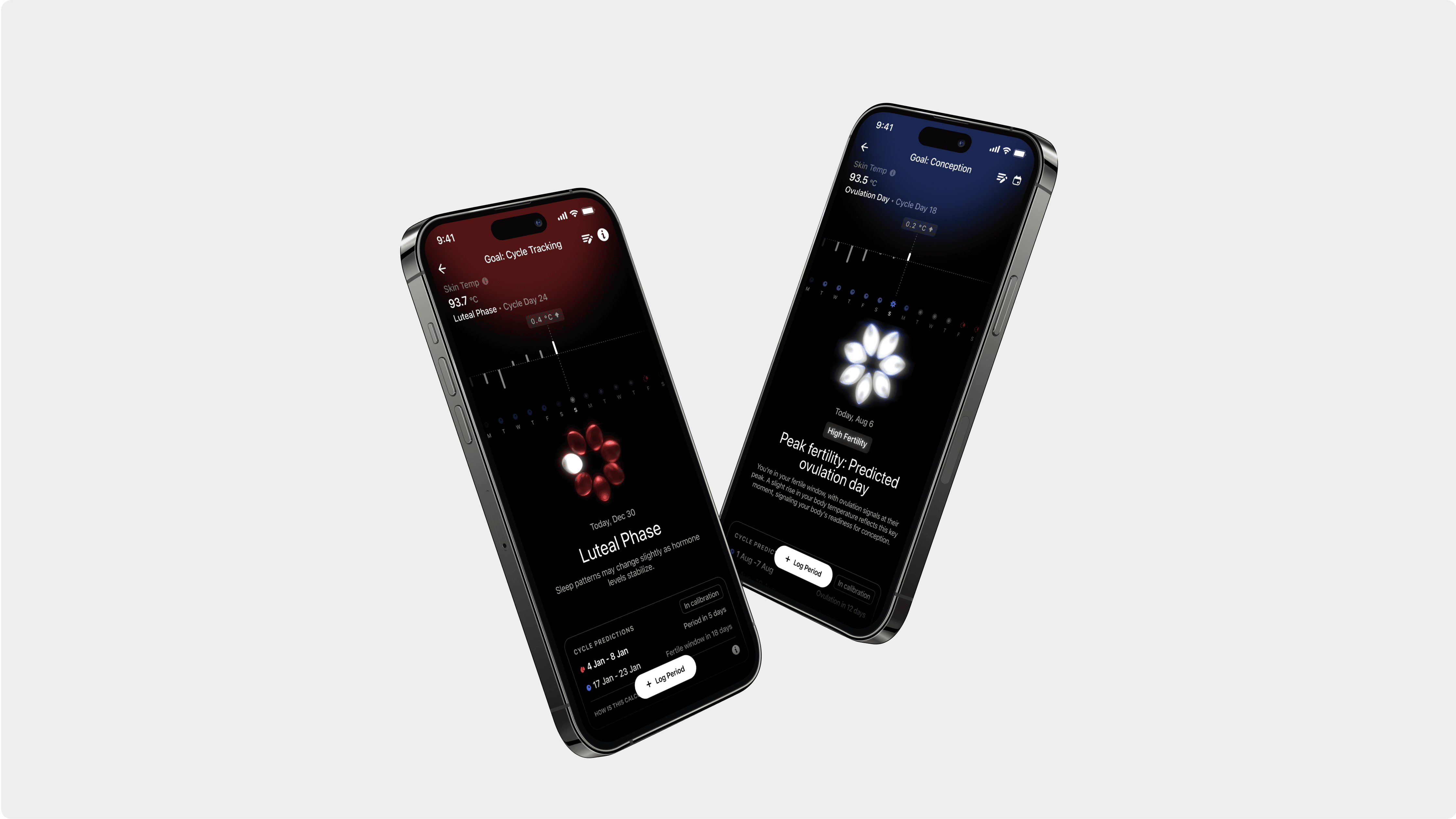
We focused on point-in-time insights instead of full-cycle views.
The system was built on cyclical biomarker deviations, designed for real logging behaviour, and structured to support two distinct intents. Cycle tracking and conception, both within the same framework.
Chapter 1: Reducing friction in cycle logging
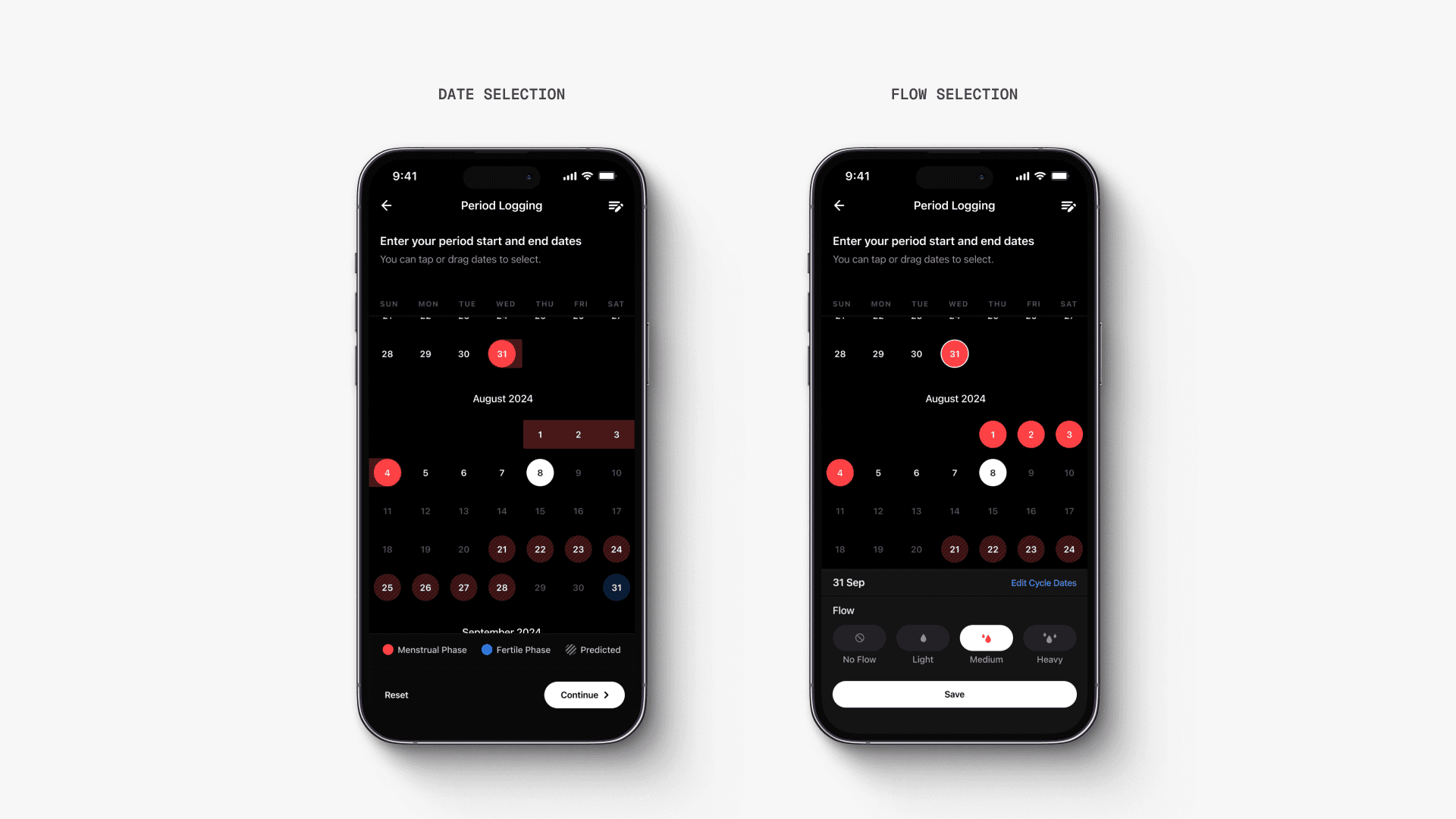
Smart logging that adapts to real behaviour
Users log inconsistently. Often late or mid-cycle. Multiple days get missed.
We introduced a one-tap logging system that auto-fills the full cycle length, while still allowing edits. This ensured completeness without increasing effort.
Separating cycle and flow logging
Cycle tracking and flow tracking are usually bundled together. This creates cluttered input flows.
We split them into distinct steps, making the interaction faster and easier to reason about.
Embedding cycle states into logging
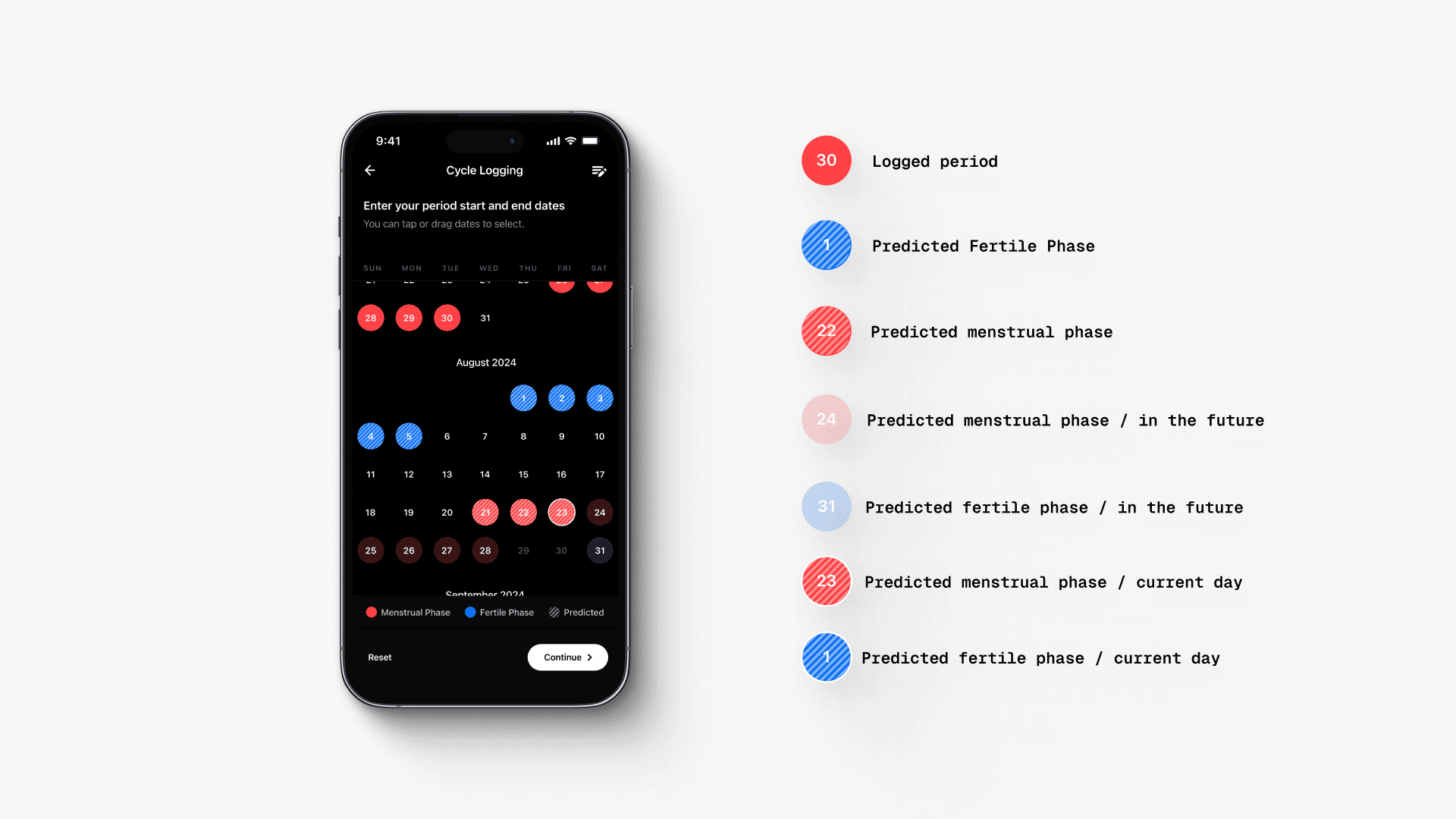
Logging was designed to be informative, not passive.
Predicted and confirmed states like ovulation, period, and transitions were surfaced directly within the interface. This improved both accuracy and user confidence.
Chapter 2: Emotional design through a new cycle metaphor
Designing beyond stereotypes
The product runs on a dark, performance-first interface.
Instead of defaulting to expected visual tropes, we extended the existing visual language and introduced a new metaphor that felt native to the product. The goal was to create something distinctive, not decorative.
Building the flower system
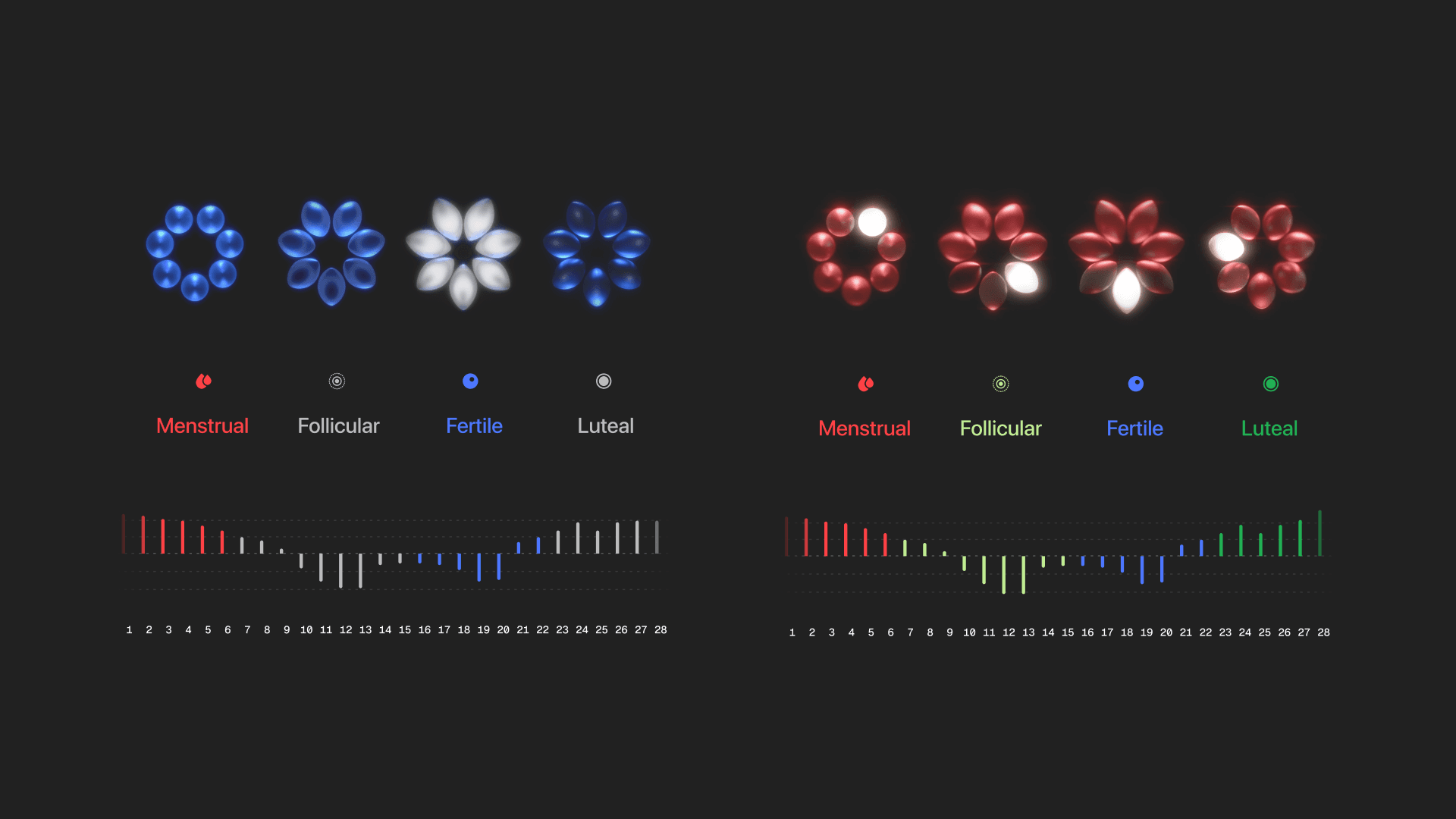
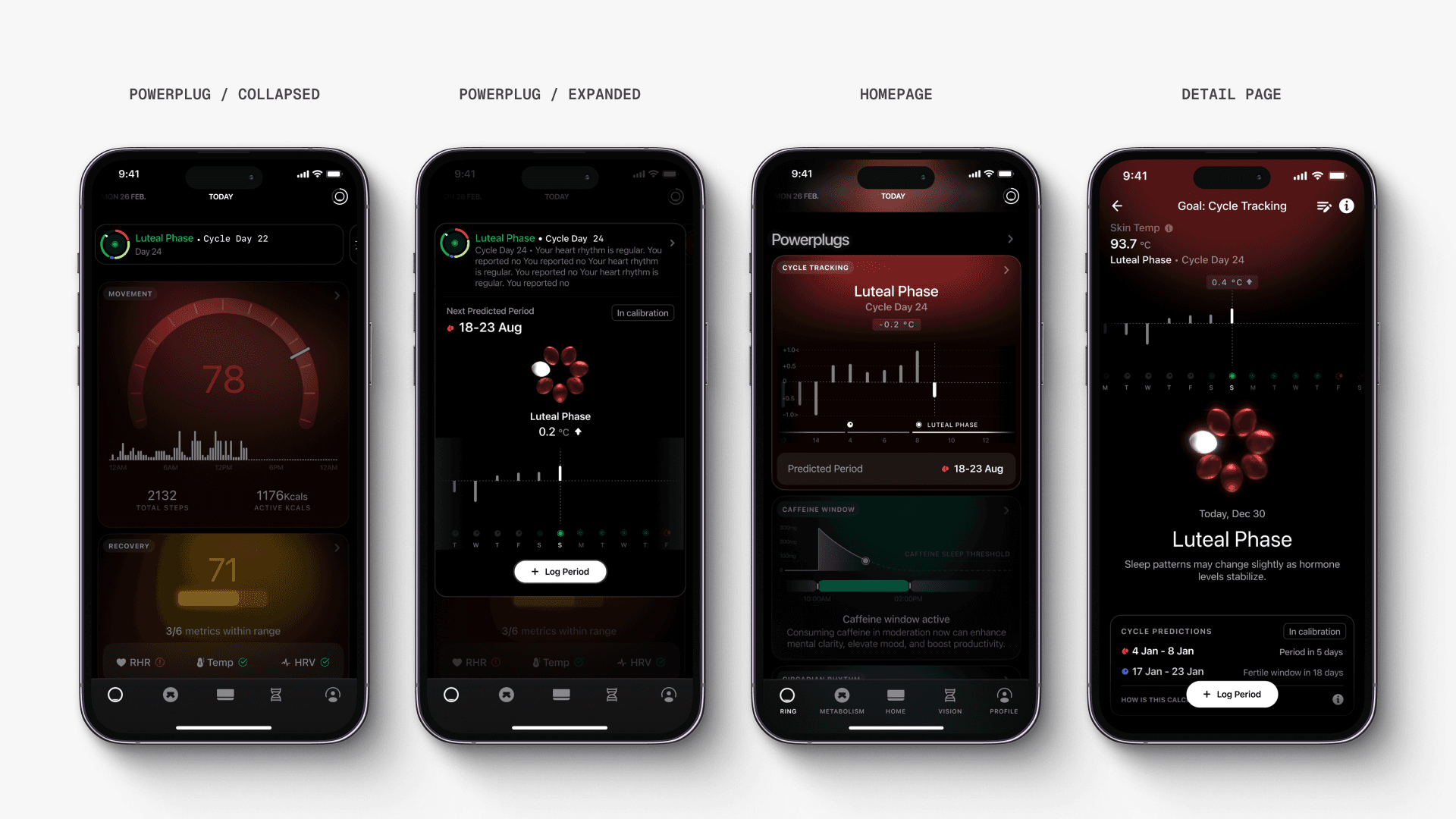
Moving away from full-cycle visualizations was deliberate. Instead of mapping all 28–30 days, we focused on the present moment — abstracting ~28-day cycles into 7 weekly segments.
The flower metaphor was intentional, not decorative. It encodes real data.
7 petals represent progression
Circular structure preserves the cycle mental model
Shape and light communicate phase
At the start, petals face the camera as circles. As they rotate, they reveal their full form, blooming at ovulation, then returning to circles.
The motion mirrors the body's rhythm — a continuous cycle, not discrete steps.
Adapting the flower differently for cycle tracking and conception
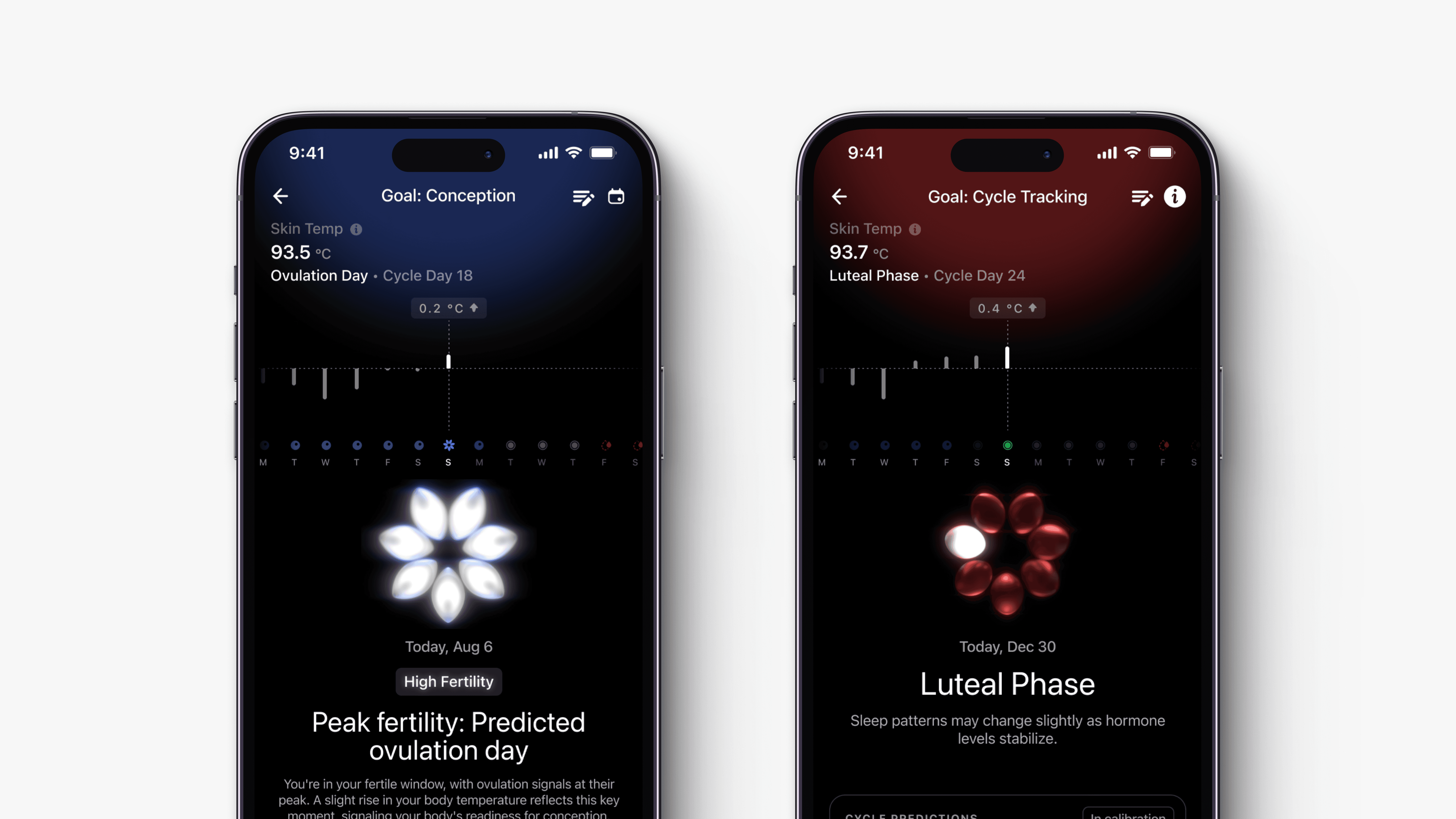
In cycle tracking, every phase carries equal weight. As the cycle progresses, the petal for that phase lights up. Each phase gets its own moment.
In conception, only ovulation matters. The other phases stay held back. The full bloom is reserved for ovulation alone — the one moment that drives the goal.
Chapter 3: Biomarker insights as the foundation
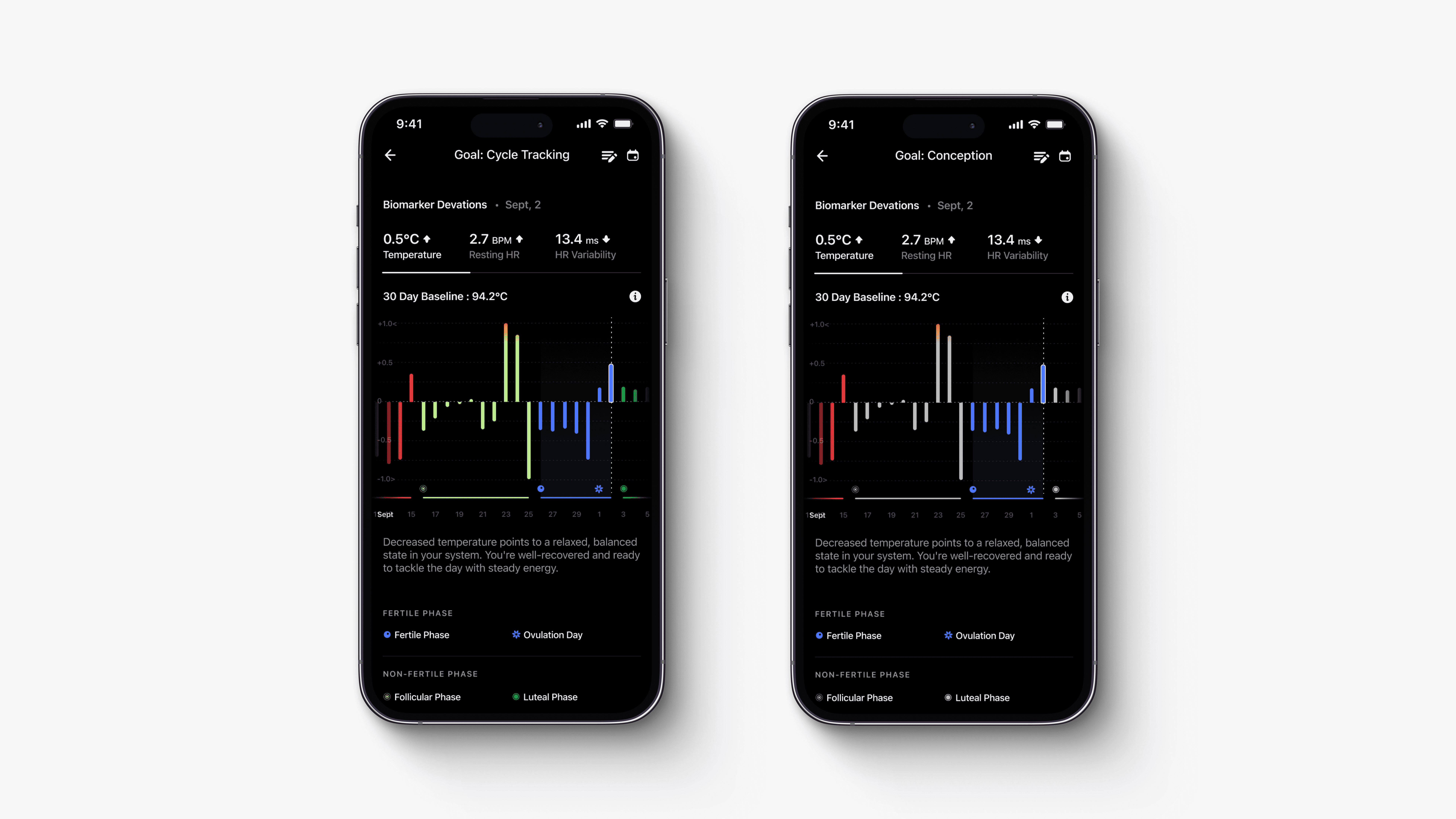
Making cyclical deviations understandable
Women’s biomarkers like temperature, HRV, and heart rate deviate in a cyclical pattern. These shifts are what enable the system to determine phases.
We visualized deviations from baseline instead of raw values. This made patterns easier to interpret and directly tied to the cycle.
Chapter 4: Structuring information for clarity
Different layouts for different goals
The user's goal is set at onboarding — cycle tracking or conception. The layout adapts from there: visuals, fertility tags, and copy each shift to surface what matters most for that goal.
Keeping insights contextual to intent
The system adapts based on user intent.
For conception, it prioritizes fertility signals and probability. For cycle tracking, it focuses on phase and progression. Deeper insights are surfaced only when relevant.
This keeps the experience focused without adding complexity.
Designing across multiple entry points
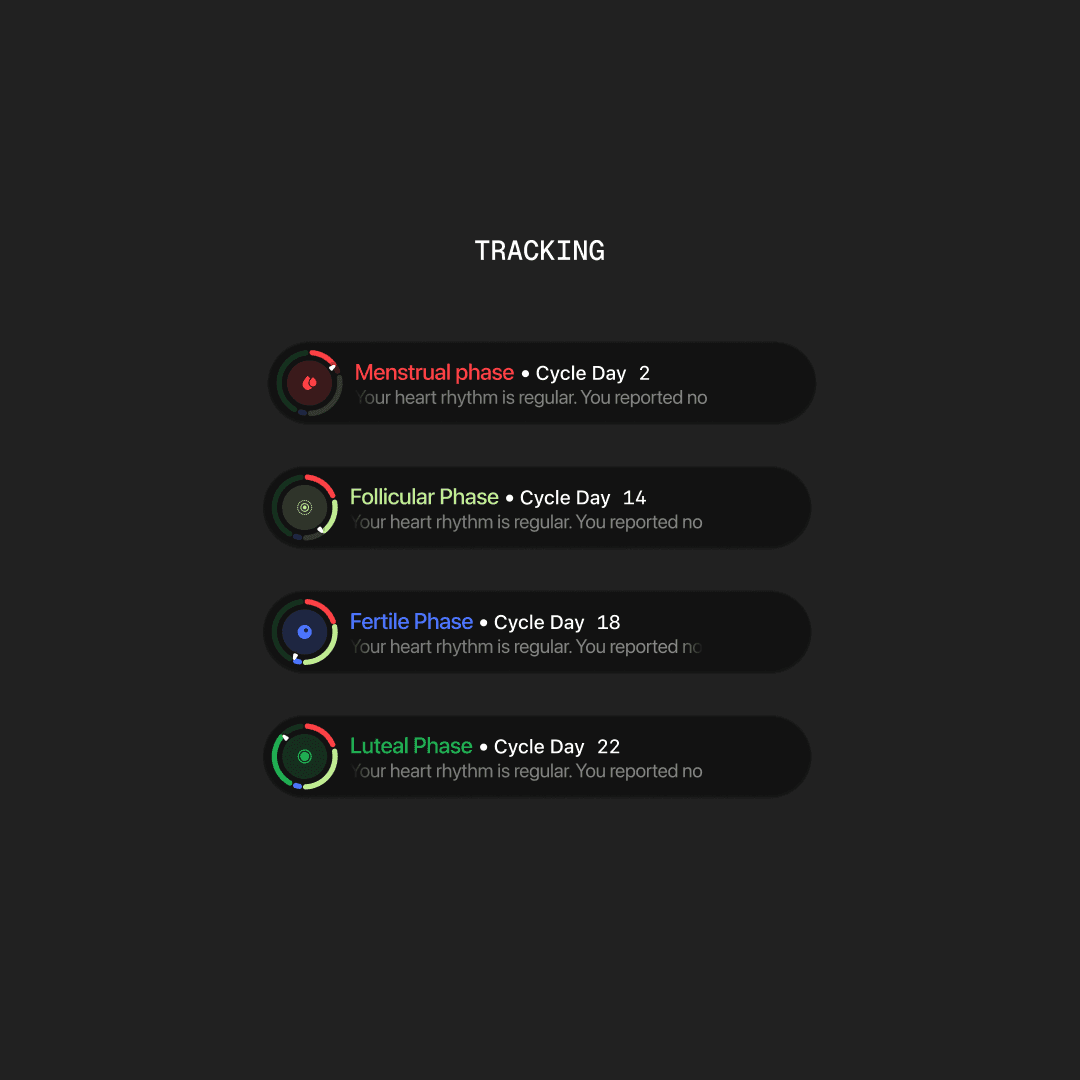
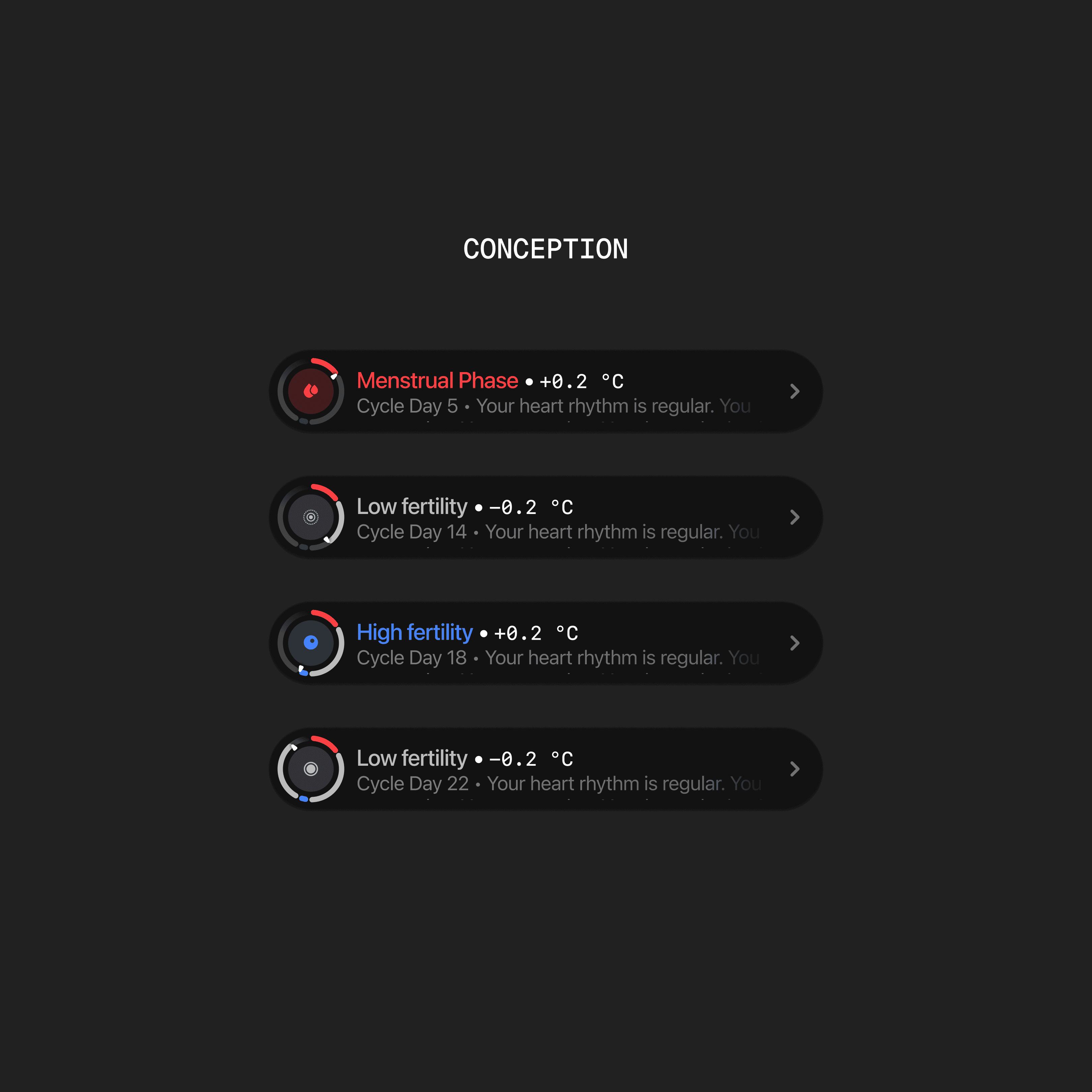
The feature exists across different surfaces in the product. A glanceable layer, a home card, and a detailed view.
Each layer uses the same system, but adapts the depth of information. This creates consistency without redundancy.
/
conclusion
The feature shipped in April 2024 and became the foundation for women's health at Ultrahuman.
It earned its place in the product. 68% of eligible women turn it on. 89.6% log a period within 30 days of enabling. 51% log 7+ cycles; 25.5% log 13+. D90 retention lifts +17pp versus matched non-cycle users — a sticky, deeply-used feature, not a one-time setup.
The free experience earned an upgrade. Cycle & Ovulation Pro shipped in July 2025 and added ~42k paying subscribers and $1.19M in direct subscription revenue in 8 months.
It also repositioned the product. Pre-launch, Ultrahuman was a male-skewing biohacker product — 28% female buyers, avg age 41, ~38k total buyers across two years. Two years post-launch, it's majority-female — 62% female buyers, avg age 35. Female Ring users grew from 10,687 to 326,614, a 30× step change. The feature was a necessary condition for reaching this cohort, alongside marketing and the broader women's health roll-out.
The system was built to scale. The same primitives and visual language extended into conception, into AI chat as the top user query, and into deeper iterations without structural changes.
The key decision was to prioritize clarity over completeness. By focusing on what matters in the moment instead of representing the entire cycle, the experience became faster to read, easier to log, and durable enough to anchor a broader women's health product.